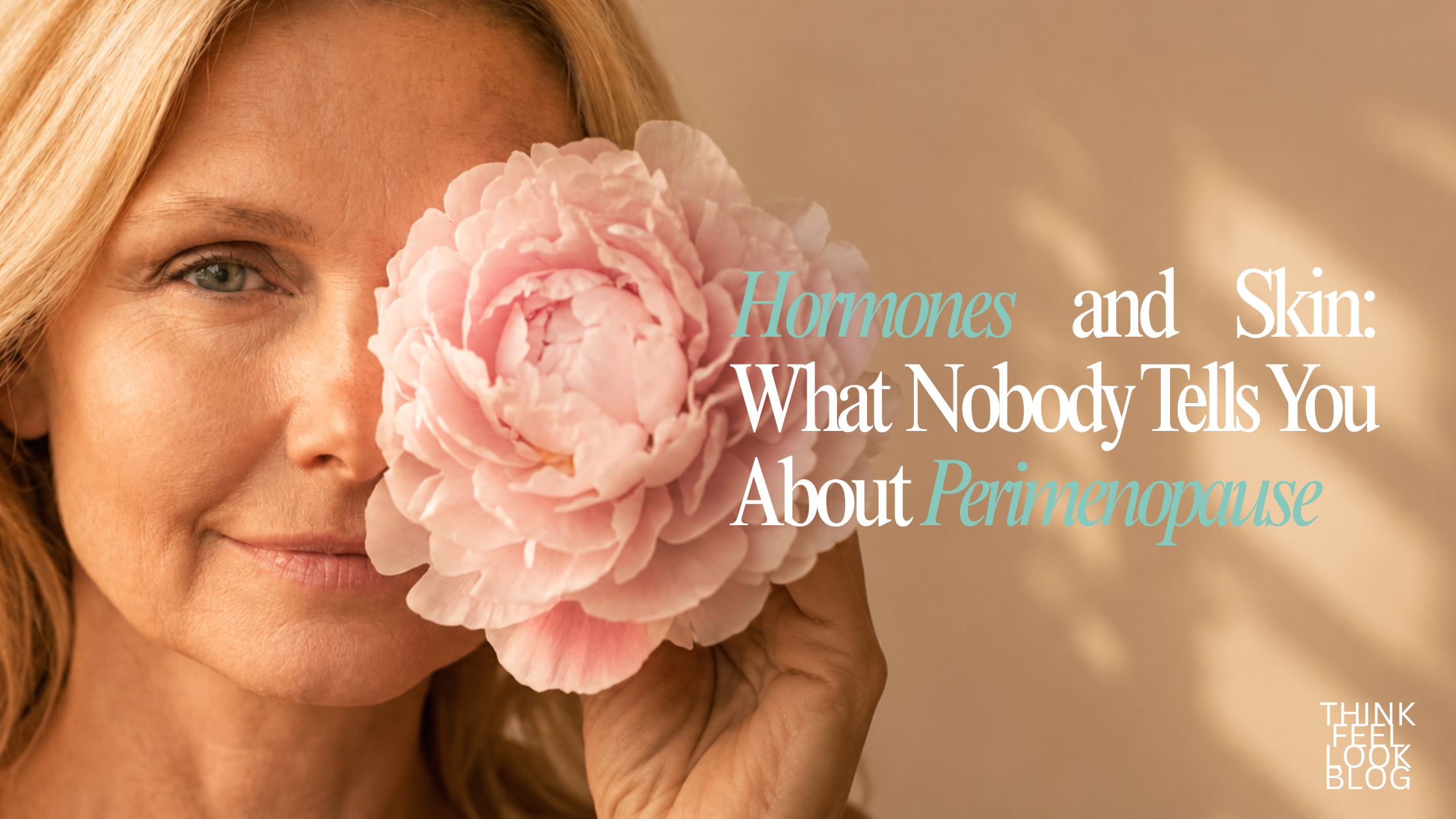
Hormones and Skin: What Nobody Tells You About Perimenopause
There is a moment many women experience somewhere in their 40s when their skin seems to change almost overnight. Products that worked for years suddenly stop working. The skin becomes drier, thinner, more reactive. Breakouts return after decades of clear skin. The jawline softens. The texture shifts in ways that are hard to describe but impossible to ignore.
Most women are not told what is happening. They are sold new products. They are told to try harder. What they are rarely told is the truth: their hormones are changing, and their skin is responding to that change in entirely predictable, manageable ways.
What Perimenopause Actually Does to Your Skin
Perimenopause, the transitional phase that can begin as early as the late 30s and typically spans several years before menopause, is characterized by fluctuating and declining levels of estrogen and progesterone. These hormones are not just reproductive. They are deeply involved in skin function.
Estrogen in particular plays a critical role in skin health:
- It stimulates collagen and elastin production. As estrogen declines, collagen loss accelerates significantly. Research suggests women can lose up to 30% of their skin collagen in the first five years after menopause.
- It supports the skin's ability to retain moisture by influencing hyaluronic acid production. Declining estrogen means drier, less plump skin.
- It regulates sebum production. The hormonal fluctuations of perimenopause can cause both increased oiliness and increased dryness, sometimes in the same skin.
- It has anti-inflammatory properties. Lower estrogen means the skin becomes more reactive and slower to recover from irritation.
Understanding this is not depressing. It is clarifying. When you know what is driving the changes, you can respond intelligently rather than reactively.
The Thinking Shift That Changes Everything
The most damaging response to perimenopausal skin changes is to treat them as a failure. To conclude that your skin is deteriorating and that the best you can do is slow the decline.
This is the wrong frame entirely.
Perimenopause is a biological transition, not a verdict. Your skin is not broken. It is operating under a new hormonal environment, and it needs a different kind of support than it did before. The women I have worked with who navigate this transition most gracefully are the ones who approach it with curiosity rather than fear. They ask: what does my skin need now? Not: why is my skin failing me?
That shift in thinking is not cosmetic. It changes the decisions you make, the products you choose, the treatments you invest in, and ultimately the results you see.
What Your Skin Actually Needs During This Transition
The priorities shift during perimenopause. Here is what matters most:
- Collagen support becomes non-negotiable. This is the time to be consistent with technologies and ingredients that actively stimulate collagen production. Not occasionally. Regularly.
- Barrier repair takes priority. A declining estrogen environment means a more vulnerable skin barrier. Gentle cleansing, ceramide-rich moisturizers, and avoiding over-exfoliation become more important than ever.
- Hydration from within and without. Hyaluronic acid topically, adequate water intake, and omega-rich nutrition all support the skin's declining ability to retain moisture.
- Inflammation management. Diet, stress, and sleep all have a more pronounced effect on perimenopausal skin than they did before. The skin is more reactive, and the lifestyle factors that drive inflammation show up more visibly.
- Consider the conversation with your doctor. Hormone replacement therapy, when appropriate and medically supervised, has well-documented benefits for skin as well as overall health during this transition. It is a conversation worth having, not a decision to make based on fear or outdated information.
You Are Not Starting Over. You Are Adapting.
The skin longevity practice you have built does not become irrelevant during perimenopause. It becomes more important. The fundamentals, consistency, the right actives, technologies that work at the structural level, lifestyle support, do not change. What changes is the emphasis and the urgency.
This is a transition that every woman who lives long enough will move through. The ones who come out the other side with skin they feel good in are not the ones who fought it. They are the ones who understood it, adapted intelligently, and kept showing up for their skin with knowledge and intention.
That is what thinking ageless looks like in practice.
Julie Lindh, Skin Expert
Written by Julie Lindh
Visit author's website

Leave a comment
This site is protected by hCaptcha and the hCaptcha Privacy Policy and Terms of Service apply.