Article: Look Younger. Still Look Like You.
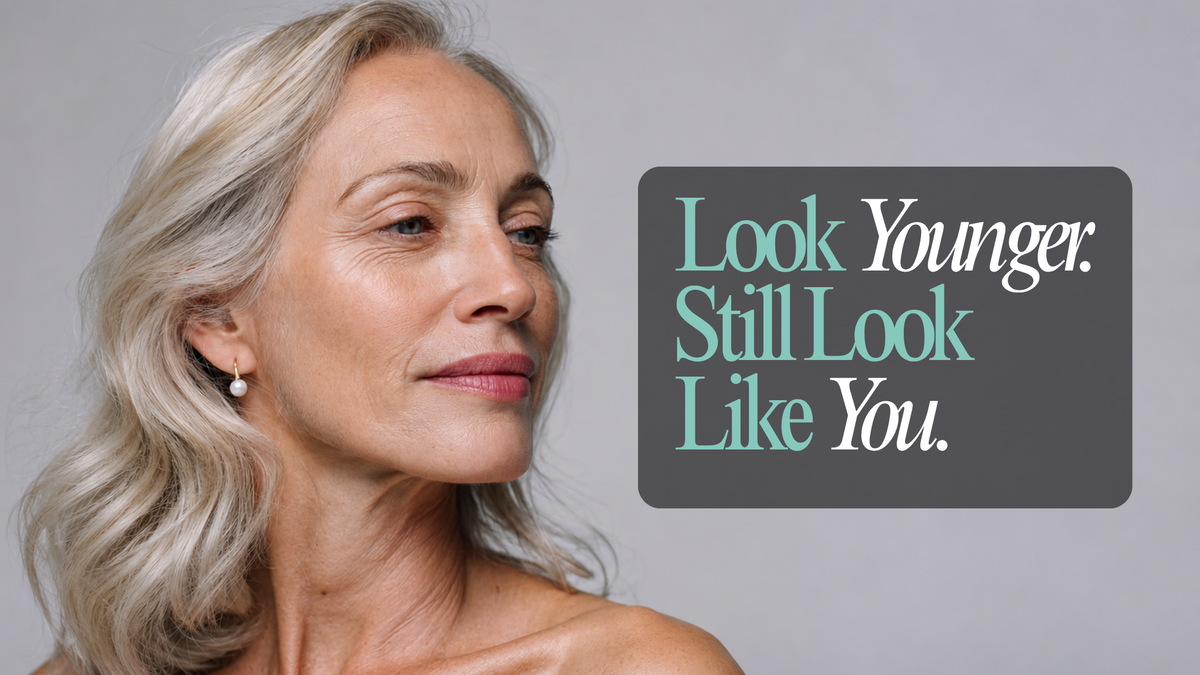
Look Younger. Still Look Like You.
“I want to look younger.”
There is nothing wrong with saying it.
You do not need to soften the request, pretend appearance does not matter or apologize for wanting smoother, fresher-looking skin.
But wanting a result and choosing how to pursue it are two different things.
What do you mean by younger? A more even complexion? Better texture? Less puffiness? A face that looks as rested as you feel?
The clearer you are, the better equipped you are to make choices that serve you.
The beauty industry has no shortage of promises. What you need is a way to judge them, rather than letting the latest promise decide what your face needs.
Before choosing what to change, understand what you are seeing. Then decide what you want to improve and what you want to preserve.
Younger is not a diagnosis
The beauty industry uses “younger-looking” to describe almost everything.
A moisturizer, an exfoliating treatment, a facial device and a medical procedure may all use the same language. That does not mean they do the same thing.
One may temporarily soften the appearance of dry surface lines. Another may address uneven pigmentation. Another may target a particular aspect of skin texture or facial structure.
The word “rejuvenation” does not explain the mechanism, the evidence or the likely result.
This is where I encourage people to become more specific.
Instead of “My whole face looks old,” try asking: what am I actually noticing?
You might discover that the concern is not your age at all. It may be skin that looks dry, an uneven tone or a tired appearance that has become more noticeable.
A specific concern gives you something useful to investigate. A judgment about your entire face does not.
Skin quality and facial structure are different
A face changes at more than one level.
The surface can become rougher, drier or more uneven in color. Expression lines may become more noticeable. Deeper changes can involve facial fat, connective tissues and bone.
Those changes are related to appearance, but they are not interchangeable.
A moisturizer can improve the look of dryness. It cannot replace lost facial volume.
An improvement in pigmentation can make the complexion look more even. It does not mean that deeper tissue has been lifted.
A face that looks less puffy for a short time has not necessarily undergone a lasting structural change.
This is not an argument against any of those improvements. It is a reason to name them accurately.
When you understand what a product or treatment is addressing, you are less likely to expect it to solve something outside its purpose.
Start by naming what you want to preserve
We are accustomed to listing what we dislike.
The line. The spot. The jawline. The area that no longer looks the way it once did.
We spend much less time naming what we value.
Your smile. The shape of your eyes. The movement of your face when you speak. The features that connect you with your family. The expression someone who loves you recognizes immediately.
Preserving those things does not mean refusing treatment. It means including them in the decision.
A useful question is: “What would I like to improve without losing what I enjoy about my face?”
That is a more personal starting point than asking which features are currently fashionable.
Your face does not need to be treated as a collection of separate problems. It belongs to a person.
Looking rested is not the same as looking expressionless
Sometimes “younger” means “less tired.”
That is worth exploring before assuming every line needs attention.
A face can look tired for different reasons. Dryness can make texture more visible. Temporary puffiness can change the appearance around the eyes. A held expression can make someone look more guarded than they feel.
Persistent changes may have other causes and deserve appropriate assessment.
The point is not to diagnose yourself from the mirror. It is to avoid jumping from one observation to a treatment that may not address it.
If you want to look rested, say that.
If you want smoother texture, say that.
If you want to preserve the expressiveness of your face, say that too.
The language you use helps shape the conversation. You do not need to borrow the industry’s most dramatic words to explain what matters to you.
“Natural” deserves a second question
I work from a skin longevity perspective without injectables. But I do not believe “natural” should be used as a shortcut for safe, effective or suitable for everyone.
It can mean several things.
It may describe someone’s preference for a non-injectable approach. It may describe a result that looks subtle. Or it may simply be a word on a product label.
Those meanings are not the same.
Non-invasive treatments can still have risks. Botanical ingredients can still irritate. A device can be marketed as gentle while being inappropriate for a particular person.
Nor does avoiding injectables mean every desired change can be achieved through skincare and facial treatments.
Different approaches have different capabilities and limits. Choosing without injectables is a valid preference, but it should come with realistic expectations, not substitute promises.
Ask what “natural” means in the recommendation you are considering. Then ask what the approach can actually do.
A photograph is not the whole result
Before-and-after photographs can be useful. They can also leave out important information.
Was the lighting consistent? Was the camera at the same angle? Was the person wearing makeup? Were their expression and head position similar?
How soon after treatment was the second image taken?
An immediate photograph may capture temporary hydration, redness, swelling or changes in puffiness. Those effects do not tell you everything about the longer-term outcome.
A photograph also cannot explain how the skin felt, what recovery involved or whether the result required repeated treatment.
I would rather see an honest account of a modest improvement than a dramatic image with no context.
When you look at a result, ask about the timeline and conditions, not just the visual difference.
More noticeable is not automatically more successful
There is a temptation to believe a treatment must create a dramatic change to justify its cost.
But success depends on the goal.
If the concern was uneven pigmentation, a more even complexion may be meaningful. If the concern was dry, uncomfortable skin, better comfort and a smoother appearance may be worthwhile.
Neither has to change the shape of the face to count.
At the same time, subtlety should not become an excuse for vague promises. You still deserve a clear explanation of what improvement is reasonably expected and how it will be assessed.
The important distinction is between a result that serves your goal and a change that merely attracts attention.
They are not always the same.
What I recommend before you choose
Start with a specific goal.
“My skin looks uneven” gives you a useful direction. “I hate how old I look” puts your entire face on trial without telling you what to do next.
Name the concern. Then learn which approaches can reasonably address it.
Ask whether the proposed treatment works on the skin’s surface, a particular skin concern or deeper structures. Ask what evidence supports it, what improvement is realistic and how long that improvement may last.
Do not let an impressive name replace an explanation.
Be clear about what you are prepared to commit to, too. Consider recovery, maintenance, cost and the home care involved. A treatment that does not fit your life may not be the right choice, even if it suits someone else.
Your daily care deserves the same thought. Use appropriate skincare consistently, protect your skin from UV exposure and stop treating irritation as proof of progress. Follow treatment-specific advice rather than assembling a routine from unrelated recommendations.
Then give your choices a fair chance to work. Constantly switching products or chasing another treatment makes it harder to understand what is helping.
Some concerns need medical assessment. Seeking the right professional is an informed decision, not a setback.
You do not need to become a skin expert. But you do need to ask questions, understand the answers and take part in the plan.
You Have a Say in How You Care for Your Skin
You cannot control every change in your face. Genetics, health, hormones and time all play a part.
But that does not make you powerless.
You can choose how you protect your skin. You can choose whether your routine supports it or repeatedly irritates it. You can seek qualified guidance, set realistic goals and build rituals that fit your life.
Those choices do not guarantee a particular appearance. They are still worth making.
This is what Skin Longevity means to me in practice: paying attention to the skin you have and making thoughtful decisions about its care over time.
Not waiting for one product to do everything. Not expecting one appointment to replace the care between treatments. And not assuming that wanting improvement means you must correct every visible sign of age.
Be ambitious about your care. Be specific about your goals. Be realistic about what each choice can deliver.
You can pursue younger-looking skin without making youth the only thing you value about your face.
Choose Improvement That Belongs to You
You are allowed to want change.
Smoother texture. A more even tone. A fresher appearance. These are valid goals, and you do not need anyone’s permission to care about them.
But make the goal yours.
A treatment should answer a concern you understand, not create a new insecurity for you to chase. A beauty ritual should support your wellbeing, not turn every evening into an inspection of your flaws.
Looking younger and looking like yourself can belong in the same conversation.
The aim is not to choose between caring about your appearance and respecting your face. It is to bring both into the decisions you make.
“Know what you want to improve. Understand your options. Then make choices you can stand behind. Your face deserves thoughtful care, not decisions made under pressure.”
Julie Lindh

Written by Julie Lindh
Visit author's website

Leave a comment
This site is protected by hCaptcha and the hCaptcha Privacy Policy and Terms of Service apply.