Article: When Your Skin Looks Tired but You Don’t
When Your Skin Looks Tired but You Don’t
You feel fine. You slept reasonably well. You have energy, plans, and things you’re looking forward to.
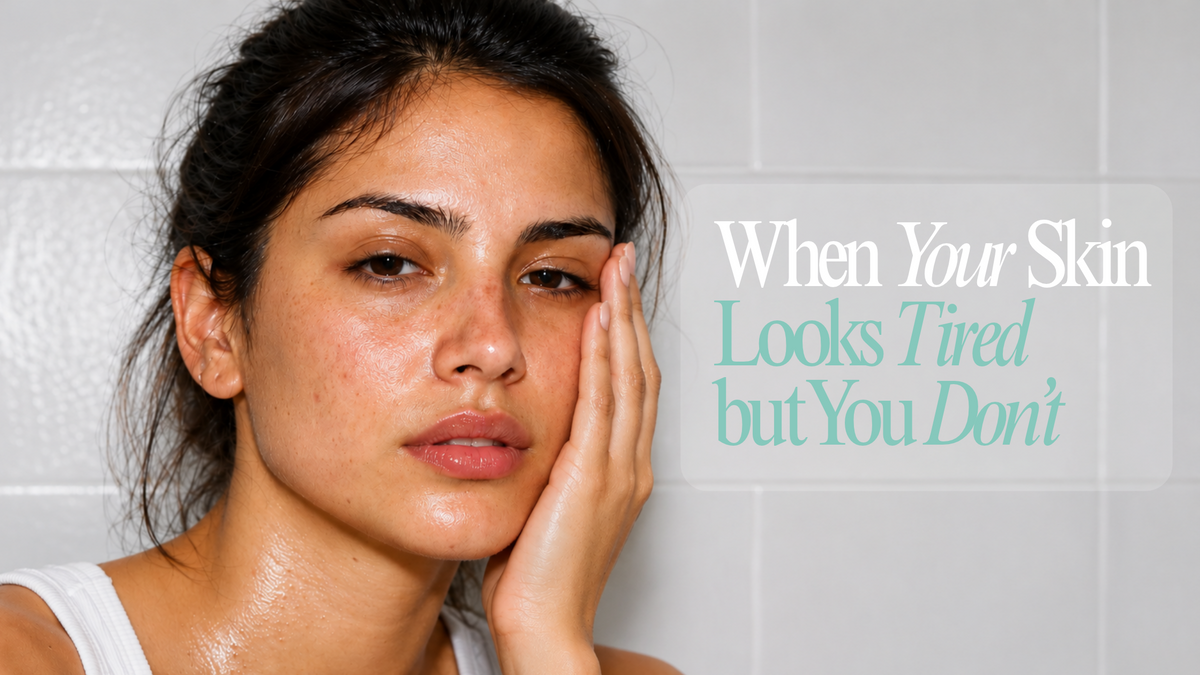
Then you catch your reflection and think, Why do I look so tired?
Sometimes someone else says it first. “Are you okay? You look exhausted.” Usually well intended. Rarely welcome.
But a tired-looking face is not always a tired person. What we read as “tired” can be a combination of surface dryness, uneven tone, puffiness, shadows, or changes in the way the face reflects light. These are different things, and they don’t all respond to the same care.
Before you reach for a stronger serum or decide you need something more aggressive, it helps to understand what you’re actually seeing.
“Tired” is an impression, not a skin diagnosis
When someone tells me their skin looks tired, my first question is: What looks different to you?
Does the surface seem dull? Are the eyes puffy? Does the skin feel tight even though it looks shiny? Is there a shadow that wasn’t as noticeable before?
Those details matter more than the word “tired.”
A face can look less fresh because the skin’s surface is dry and rough. It can also look that way because of pigmentation, facial anatomy, or gradual changes in skin firmness and facial volume. Sometimes several things are happening together.
The mistake is treating them as one problem. Adding exfoliation to already irritated skin will not make it look more rested. An eye cream cannot replace lost facial volume. And drinking more water is not a complete skincare plan.
Good care starts with a more specific question.
When dullness is really a surface issue
Healthy-looking skin doesn’t have to be glossy. But when its surface becomes dry or uneven, it can lose some of the softness and light reflection we associate with freshness.
You might notice that makeup sits differently, fine lines look more obvious, or your usual products no longer feel comfortable.
It is tempting to scrub this away.
Sometimes appropriate exfoliation can improve the look of roughness. But sometimes the skin needs less removal and more support. If you are already using retinol, exfoliating acids, or several active products, adding another “brightening” step may leave you looking less fresh, not more.
Look at how your skin feels as well as how it looks. Stinging, persistent tightness, redness, and flaking are reasons to reassess the routine, not push harder.
Start with gentle cleansing and a moisturizer your skin tolerates well. Keep daily sun protection consistent. If the skin is uncomfortable, give it a chance to settle before deciding it needs more stimulation.
There is nothing unsophisticated about meeting a basic need properly.
Dehydration and dryness are not quite the same
People often use these words interchangeably, but they describe different concerns. Dry skin generally lacks sufficient oil, while dehydration refers to a lack of water in the skin’s outer layers. They can overlap, and oily skin can also feel dehydrated.
From the mirror, both may show up as a less supple surface or more noticeable fine lines.
This is where product texture alone can be misleading. A lightweight hydrating serum may feel lovely but may not be enough on its own. Your skin may also need a moisturizer that helps reduce moisture loss.
Think about what happens several hours after your routine, not only how your face feels immediately afterward. Is it still comfortable? Does it become tight by midday? Are you cleansing until it feels squeaky clean?
You do not necessarily need more products. You may need a gentler cleanser, a different moisturizer, or less frequent use of something that is drying your skin.
And yes, drink water for your overall health. Just don’t expect an extra glass to do the job of a well-matched skincare routine.
Puffiness and shadows need different thinking
The eye area can change the impression of the whole face.
But “my eyes look tired” might mean morning puffiness, darker pigmentation, visible blood vessels through thin skin, or shadows created by facial contours. Often it is a mixture.
That distinction matters because an approach that helps temporary puffiness may do very little for a structural shadow.
For occasional puffiness, a cool compress and gentle handling may offer temporary improvement. Avoid rubbing, pulling, or using aggressive massage around the eyes. More pressure is not more effective care.
With dark circles, be cautious about promises. Skincare may help some contributing factors, but no cream can reliably erase every type of under-eye darkness. Sometimes what looks like discoloration is partly a shadow.
If swelling is new, persistent, painful, or noticeably one-sided, seek medical advice rather than treating it as a beauty concern. The same applies to sudden or unexplained changes that don’t feel normal for you.
Knowing when a concern belongs outside the treatment room is part of looking after your skin well.
Firmness is not the same as volume
A face can begin to look more tired even when its surface is well cared for.
Over time, changes happen in the skin and in the tissues beneath it. Facial contours shift. Certain areas may look less supported. Shadows can become more noticeable.
This is not simply a hydration problem.
I make a distinction between improving skin quality and changing facial structure because they are often spoken about as though they are interchangeable. They are not.
Skincare can support the skin’s appearance and condition. Certain professional treatments can address particular concerns with texture, tone, or firmness. But those improvements are not the same as replacing volume or repositioning tissue, and results vary.
This doesn’t mean you must pursue a structural treatment. It means your expectations should match the approach you choose.
You can want younger-looking skin and still be thoughtful about what you are willing to do. You can choose gradual improvement. You can decide that some changes bother you and others don’t.
The important thing is not being sold a solution for a different concern.
Your face may be holding effort
There is another part of this conversation that is easy to overlook: expression.
A clenched jaw. A furrowed brow. Eyes narrowed at a screen. Lips pressed together while concentrating.
These habits can contribute to an impression of strain even when you don’t feel emotionally overwhelmed.
Pause for a moment. Let your teeth separate. Soften your forehead. Notice whether you are holding your shoulders close to your ears.
This is not a promise that relaxing your face will reverse aging. It is simply an invitation to notice how much effort you may be carrying without realizing it.
Gentle touch can be a pleasant part of that pause. Facial massage should not hurt, leave bruising, or involve forceful pulling. If you have sensitive or inflamed skin, or have recently had a procedure, ask your treating professional what is appropriate.
You are not trying to force your face into a different shape. You are giving yourself a moment to stop bracing.
Make one useful change, not six hopeful ones
When you dislike what you see in the mirror, changing everything can feel productive.
But if you add a new cleanser, exfoliant, serum, eye cream, and device at once, you lose the ability to understand what is helping. You also increase the chance of irritation.
Instead, identify the main concern.
If it is discomfort and surface dryness, begin there. If it is recurring puffiness, notice the pattern rather than immediately buying something. If it is persistent pigmentation or a change in firmness, get an assessment that distinguishes what skincare can reasonably do from what it cannot.
Keep your core routine steady while you make a considered adjustment. Give it time appropriate to the concern rather than judging every morning.
And try not to assess your face only under harsh overhead lighting or through a magnifying mirror. Those are very particular views of a face. They are not the whole picture.
Fresh does not have to mean flawless
When someone says they want to look less tired, they are not necessarily asking to look younger by a certain number of years.
Often, they want their reflection to feel more like them. A little clearer. A little softer. Less strained.
That is a reasonable wish.
The path there begins with understanding, not criticism. What needs moisture? What needs a gentler routine? What deserves professional attention? And what is simply part of your face, rather than evidence that you are doing something wrong?
A face with expression, history, and character can still look fresh.
Care for what needs care. Be realistic about what each choice can change. And don’t let the word “tired” persuade you that your whole face needs fixing.

Written by Julie Lindh
Visit author's website

Leave a comment
This site is protected by hCaptcha and the hCaptcha Privacy Policy and Terms of Service apply.