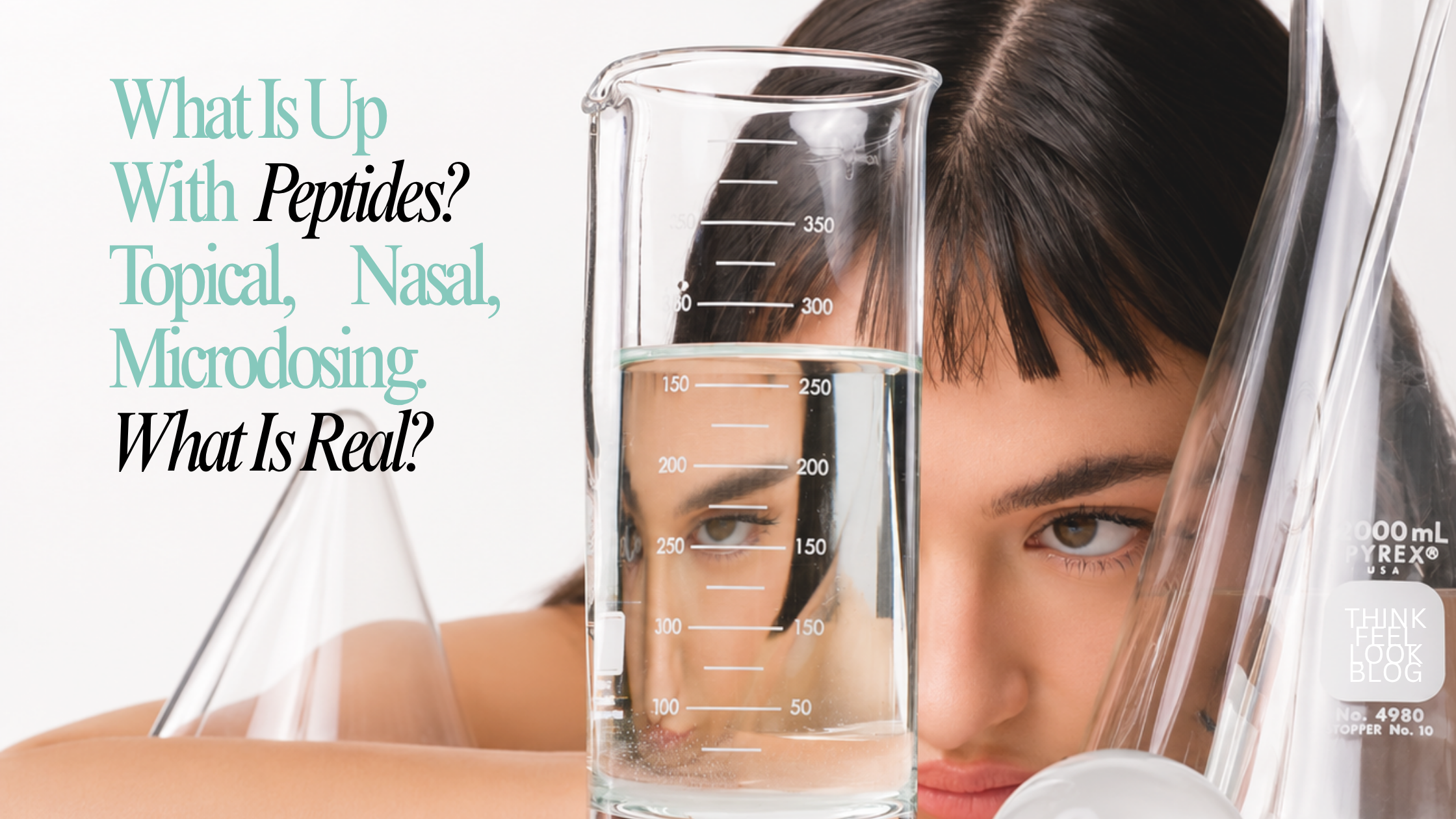
What Is Up With Peptides? Topical, Nasal, Microdosing. What Is Real?
Peptides are having a moment. They are in your serum, your eye cream, your collagen supplement, and now apparently your nasal spray. Biohackers are microdosing them. Clinics are injecting them. The internet is calling them the future of skin longevity.
So what is actually going on? Are peptides genuinely transformative, or is this another wave of sophisticated marketing dressed up in science language?
The honest answer is: both. And knowing the difference matters.
What Peptides Actually Are
Peptides are short chains of amino acids, the building blocks of proteins. Your skin is largely made of proteins, primarily collagen, elastin, and keratin. When these proteins break down, they release peptide fragments that act as biological signals, essentially telling the body that repair is needed.
Synthetic peptides in skincare are designed to mimic these signals. The idea is straightforward: deliver the right signal to the skin, and the skin responds by producing more collagen, reducing inflammation, or relaxing muscle contractions that cause expression lines.
This is real science. Peptides do function as cellular messengers. The question is not whether the mechanism exists. The question is whether the delivery method actually works.
Topical Peptides: Effective, With Caveats
Topical peptides have the most evidence behind them and the longest track record. Ingredients like Matrixyl (palmitoyl pentapeptide-4), Argireline (acetyl hexapeptide-3), and copper peptides have genuine research supporting their function in stimulating collagen synthesis, improving skin texture, and reducing the appearance of fine lines.
The caveat is penetration. Peptides are relatively large molecules, and the skin barrier is designed to keep things out. Formulation matters enormously. A peptide in a poorly designed formula, or layered under ingredients that degrade it, may never reach the cells it is meant to signal.
This is why the source and formulation of your topical peptide products matters as much as the ingredient list. Not all peptide serums are equal. Not even close.
Nasal Sprays and Microdosing: A Different Category Entirely
The peptides being used in nasal sprays and microdosing protocols are a different class altogether. We are talking about research peptides like BPC-157, TB-500, GHK-Cu, and others that are being used systemically, meaning they enter the bloodstream and act throughout the body, not just on the skin surface.
Some of these have genuinely interesting research behind them, particularly around tissue repair, inflammation reduction, and cellular regeneration. BPC-157, for example, has shown significant results in animal studies for wound healing and gut repair. GHK-Cu has research supporting collagen stimulation and anti-inflammatory effects.
But here is what you need to know: most of this research is preclinical. Animal studies and in vitro work. Human clinical trials are limited. The long-term safety profiles are not fully established. And the regulatory landscape is shifting, with many of these peptides moving into grey or restricted areas in several countries.
This does not mean they are dangerous. It means we do not yet have the full picture. Anyone presenting systemic peptide use as a proven, risk-free skin longevity strategy is ahead of the evidence.
So Are Peptides the Next Skin Longevity?
Topical peptides, used correctly in well-formulated products, are a legitimate and valuable part of a skin longevity practice. They are not magic, but they are real. They work best as part of a layered approach alongside other methods that support the skin's own repair mechanisms.
Systemic peptides are a frontier, not a foundation. The science is genuinely exciting, and it is worth watching. But it is not yet at the stage where I would recommend it as a cornerstone of a skin longevity practice, particularly without medical supervision.
What I would say is this: the most powerful peptide delivery system available to you right now is your own body. Collagen production can be stimulated through multiple pathways: targeted energy-based technologies, specific active ingredients, improved circulation, reduced chronic inflammation, quality sleep, and the right nutritional support. These are not workarounds. They are the mechanisms your skin already uses.
The tools exist. The science is there. Build your practice on what is proven, stay curious about what is emerging, and be honest about the difference between the two.
Julie Lindh, Skin Expert

Written by Julie Lindh
Visit author's website


Leave a comment
This site is protected by hCaptcha and the hCaptcha Privacy Policy and Terms of Service apply.